


Overview:
Palau’s tourism sector surged in 2025, with visitor arrivals up 27% through November as China, Taiwan, Japan, the U.S./Canada and Europe fueled a broad-based recovery. Expanded air routes, longer stays and new services set the stage for continued growth in 2026, with arrivals projected to reach as high as 75,000.
By: L.N. Reklai
KOROR, Palau (January 9, 2026) — Palau’s tourism industry posted a strong, broad-based recovery in 2025, with international arrivals climbing sharply across Asia, North America and Europe, supported by expanded air links and longer visitor stays that position the destination for further gains in 2026.
From January through November 2025, Palau recorded 64,195 international visitors, a 27% increase from 50,684 over the same period in 2024. November alone brought in 6,825 arrivals, up 46.7% year over year and 5.5% from October, signaling strong momentum into the final quarter.
China remained Palau’s largest single source market, accounting for 21,115 visitors, up 28% from a year earlier and representing about one-third of all arrivals. Taiwan followed with 12,384 visitors, an 11% increase that underscored its role as a stable, high-volume market.
Long-haul markets also showed steady gains. The United States and Canada together sent 10,419 visitors, up 11%, while Japan rebounded sharply with 6,526 arrivals, a 27% increase driven by new and reinstated direct flights. Europe emerged as the fastest-growing long-haul market, with 5,058 visitors, a 63% jump from 2024.
Smaller but rapidly expanding segments added to the recovery. Australia more than doubled to 2,656 visitors, up 107%, following the launch of new regional air links. Arrivals from other markets reached 5,137, up 48%, highlighting a widening source mix, while South Korea recorded 900 visitors, up 11%.
Market mix shows diversification
China accounted for about 33% of total arrivals in the January–November period, followed by Taiwan at 19% and the U.S./Canada at 16%. Japan represented roughly 10%, Europe and other markets about 8% each, Australia 4%, and South Korea around 1% to 2%.
The distribution confirms a China-anchored but increasingly diversified tourism portfolio, with Asia providing most of the volume and North America and Europe contributing higher-value, longer-stay visitors.
Air connectivity underpins growth
The recovery has been underwritten by a complex mix of scheduled and charter air services. China Airlines continued to operate scheduled flights from Taiwan, increasing frequency to four flights per week in 2025 and carrying nearly half of all Taiwan visitors, as well as notable shares of European and other travelers.
United Airlines operated 10 scheduled flights per week to Koror, including services from Guam and Manila and two new direct flights from Tokyo’s Narita airport launched in late October. United accounted for the majority of Japanese arrivals and significant shares from the U.S./Canada and other markets.
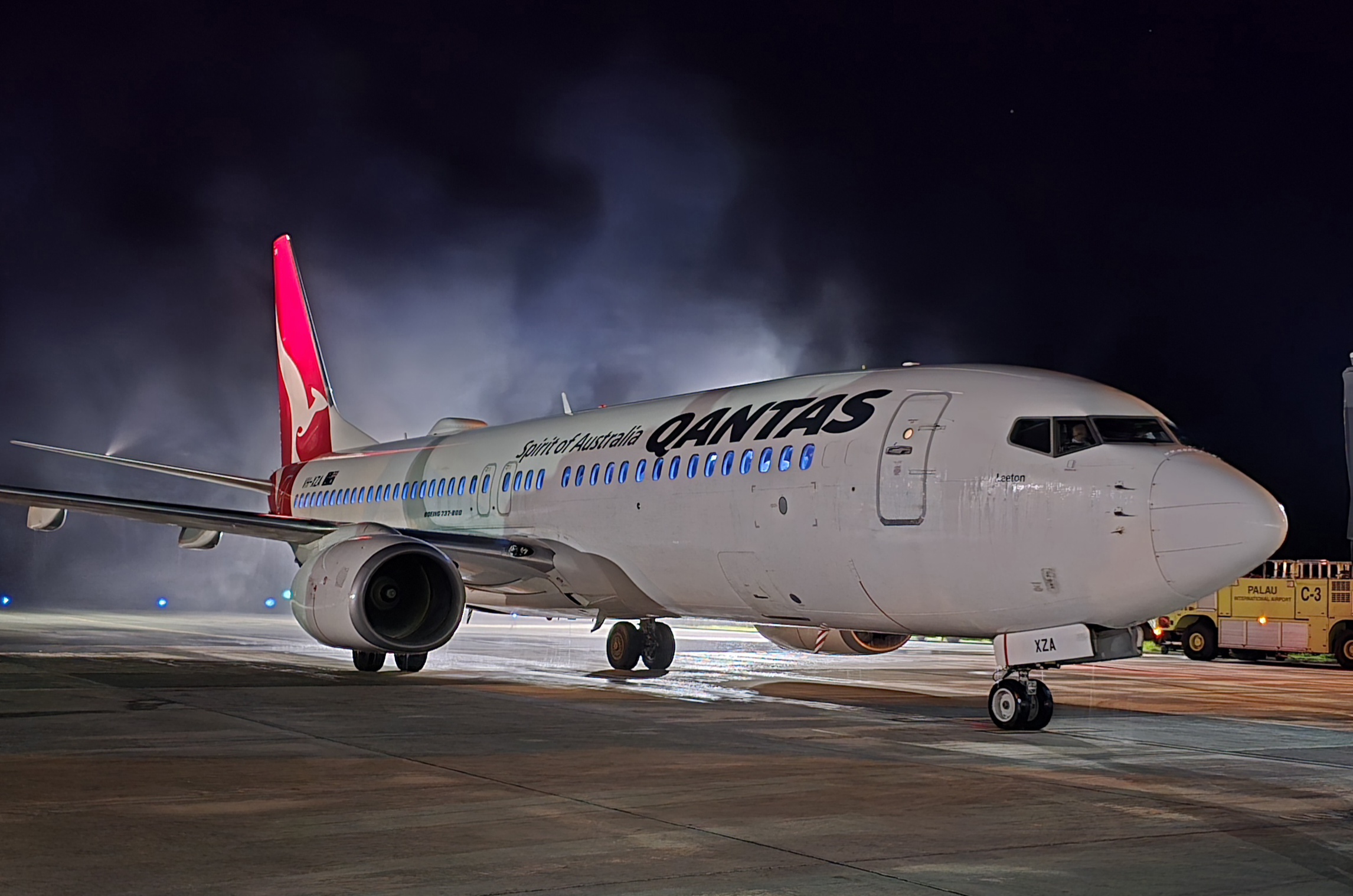
Charter services from Macau and Hong Kong, operated by Cambodia Airways, Hong Kong Airlines and Greater Bay Airlines, remained heavily concentrated on China and Greater China demand. Qantas maintained a weekly Brisbane–Palau service, handling about two-thirds of Australian traffic, while Nauru Airlines’ “Island Hopper” route linked Palau with Australia and several Pacific islands, supporting Europe and other markets.
Regional connectivity was further supported by Pacific Mission Aviation’s Yap–Palau service, along with small but targeted flows from private aircraft, military flights, cruise ships, yachts and research vessels.
From collapse to recovery
Tourism arrivals collapsed during the COVID-19 pandemic, falling to 18,308 in 2020 and just 5,231 in 2021. A gradual rebound began in 2022 with 12,328 visitors and accelerated in 2023 to 41,227. By 2024, arrivals reached 56,184, and by November 2025 totals had already surpassed that level, moving closer to pre-pandemic volumes of more than 90,000 visitors recorded in 2018 and 2019.
Industry officials attribute the rebound to stronger Asian connectivity, targeted marketing by the Palau Visitors Authority — including dive campaigns, social media outreach and partnerships with international tour operators — and longer average stays in long-haul markets that boost visitor nights and spending.
2026 outlook
Looking ahead, arrivals in 2026 are expected to continue rising, though at a more moderate pace off the higher 2025 base. Positive factors include the first full year of United’s Tokyo–Koror service, expanded frequencies by China Airlines, continued operations by Qantas and Greater Bay Airlines, and sustained charter activity from Macau and Hong Kong.
A key addition will be Philippine Airlines’ new twice-weekly Palau–Philippines route, scheduled to launch in March 2026 following regulatory approval. The service is expected to open a new Southeast Asian gateway, tapping Philippine outbound leisure travel and connecting traffic from Japan, Korea, the Middle East and Europe.
Balancing these drivers against potential constraints such as aircraft availability and regional economic or geopolitical risks, a conservative projection places total 2026 arrivals at about 70,000 to 75,000 visitors, representing growth of roughly 8% to 15% over an estimated full-year 2025 total.
China is likely to remain the largest single market, though its share may stabilize as Japan, Australia, Europe and new Philippines-linked flows expand. Japan’s share is expected to rise on a full year of direct service, while Australia and Europe are well positioned to continue posting double-digit growth from smaller bases.
Taken together, the outlook suggests Palau is edging closer to its pre-COVID tourism volumes, with a more diversified market mix, improved Asia-Pacific connectivity and a higher proportion of long-stay, higher-spending visitors heading into 2026.