


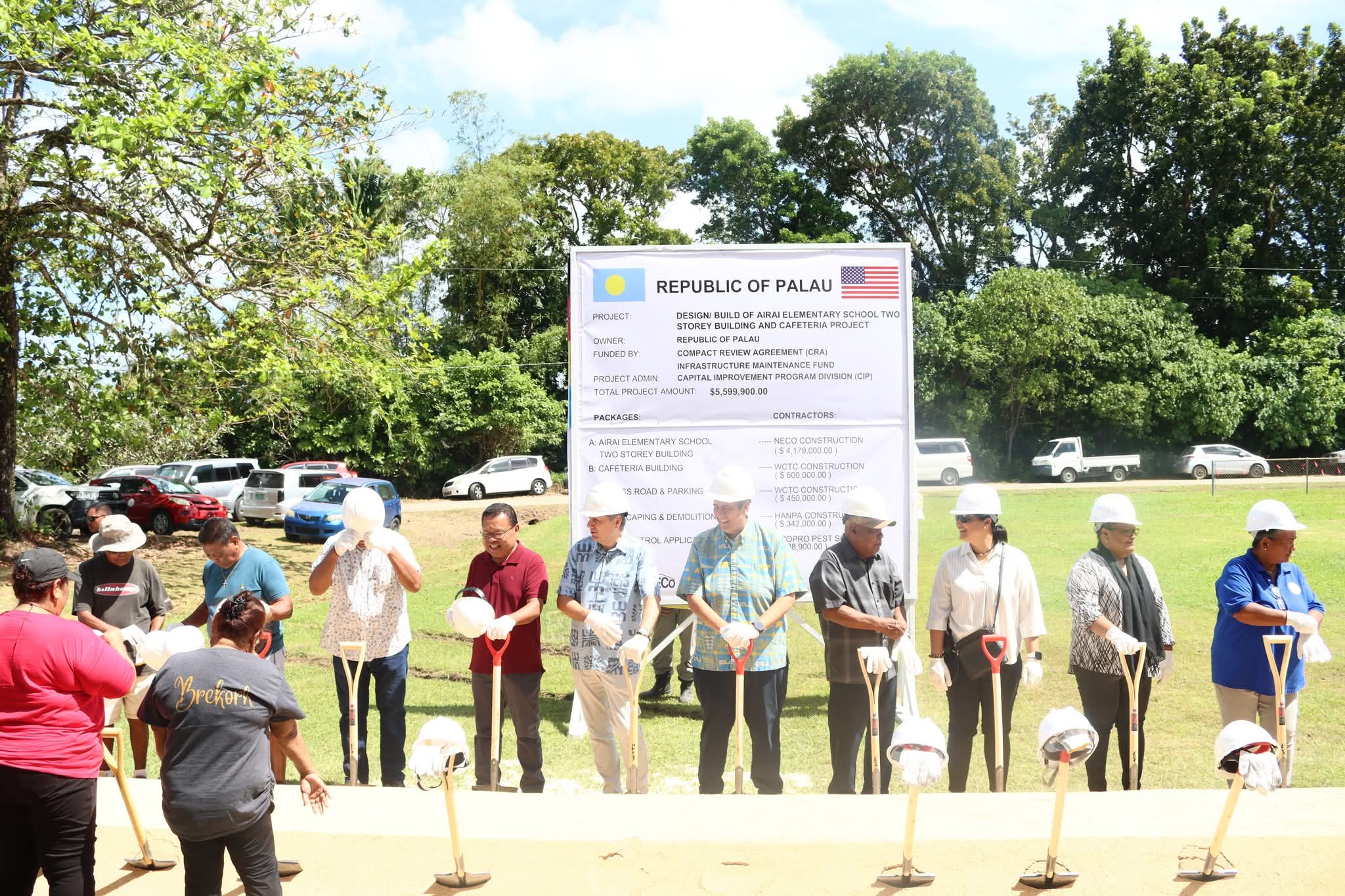
Overview:
A new report by the Lowy Institute shows that while Palau ranks among the Pacific’s wealthiest nations per capita, it continues to rely heavily on foreign aid. The findings highlight shifting donor trends, national spending priorities, and emerging gaps in key sectors.
By: Summer Kennard
KOROR, Palau (March 24, 2026) New data from the Lowy Institute highlights Palau’s continued reliance on international assistance, even as its economy ranks among the strongest per capita in the Pacific. The findings, published in October 2025, draw on development finance data collected between 2008 and 2023.
With a population of just 17,800, Palau is the fourth-smallest economy in the region. It holds the third-highest GDP per capita at $15,859, yet remains highly aid-dependent, with external assistance accounting for 12 percent of its GDP, one of the highest ratios in the Pacific.
In 2023, 88 percent of Palau’s development support came from four major partners: Taiwan (28 percent), Japan (24 percent), the United States (19 percent), and Australia (17 percent). According to the Lowy Institute’s Pacific Aid Map, the data reflects a shifting donor landscape, with Taiwan and Japan increasing their contributions in recent years, while the United States remains a consistent long-term partner.
Aid distribution also reveals Palau’s domestic priorities. Nearly half–47percent–of all funding is directed toward Government and Civil Society, significantly higher than the regional average of 38 percent. This indicates a strong emphasis on governance and institutional support. Other key sectors include Transport and Storage (12 percent) and Energy, pointing to continued investment in infrastructure.
Yet, as aid flows into the region, there can be a disconnect between funding levels and what communities actually experience. “There is this gap between the idea of the money or where it might go and what is tangibly there,” said Riley Duke
However, the data shows Palau spends less than the regional average on Health and Humanitarian Aid, suggesting potential gaps or different national priorities compared to its Pacific neighbors.
On global policy goals, Palau performs strongly in climate-focused funding. Over the past five years, 14 percent of its aid has targeted climate-related initiatives, above the regional average, reflecting the country’s vulnerability to climate change and commitment to resilience.
In contrast, gender equality remains an area of lower investment. Only 13 percent of aid is directed toward gender-focused initiatives, falling short of the Pacific average of 22 percent.
The Lowy Institute data also shows a shift in how Palau receives its funding. While grants have remained relatively stable since 2008, loans have become increasingly prominent, particularly following a sharp spike in 2021 driven largely by borrowing. Since 2014, loans have made up about one-third of total assistance.
This trend reflects a broader regional pattern. “Most of that really additional COVID support has fallen back out of the region,” Duke noted, pointing to a return to more stable, pre-pandemic aid levels
Despite this shift, Palau’s financial outlook remains stable. The International Monetary Fund currently assesses the country as having a low risk of debt distress, indicating that its borrowing levels are manageable.
Overall, the figures paint a picture of a small island nation that is well-supported by key partners but still navigating development challenges. As aid flows evolve, the balance between governance, infrastructure, and social priorities will play a crucial role in shaping Palau’s future.