


Overview:
Palau invented giant clam farming in the 1970s — then watched the rest of the Pacific build industries from the technology while its own languished. Now, a two-year project funded by New Zealand's Manaaki Fund and driven by the Palau Aquaculture Alliance is trying to change that. With a new community hatchery producing 25,000 seedlings a year, business training for 90 farmers across six states, and a market framework taking shape, the pieces are finally coming together. But passing critical CITES legislation and sustaining momentum beyond donor funding remain the next big tests. This is the story of a community betting on its ocean — and on itself.
Read the full story: Palau's Giant Clam Comeback: Inside the Grassroots Project Turning a Conservation Crisis Into an Industry
Giant clams could be Palau’s golden egg-laying goose — if the island nation can build the industry right
By [L.N. Reklai |
KOROR, Palau (June 25, 2026)— In a sun-drenched aquaculture facility in Aimeliik, something quietly historic is happening. A satellite hatchery — the first ever non-government clam hatchery in Palau, Watson & Sons Aquaculture — is now producing giant clam seedlings and distributing them to community farmers across the archipelago. It is a modest building, but it represents the leading edge of a potentially transformational shift in how Palau feeds its people, earns its living, and protects its legendary reefs.

“Giant clams could be our golden egg-laying goose if we get it right,” said Tarita Holm, Palau country representative for Conservation International and consultant of the two-year Manaaki Project, which concluded this month. “We just have to overcome several barriers.”
Those barriers, it turns out, are substantial — but not insurmountable.
THE STAKES
Palau is home to seven of the world’s twelve giant clam species, a biological distinction that doubles as an economic opportunity. Giant clams filter seawater, expel nutrients that feed coral and reef fish, and attract the divers and snorkelers who drive Palau’s multi-million-dollar tourism industry. They are, in the parlance of ecologists, a keystone species. They are also, increasingly, being eaten.

Rising demand from tourism and a higher cost of living have fueled overharvesting of wild populations. Species like Tridacna gigas — the world’s largest marine bivalve — face mounting pressure. Palau’s government is moving toward a ban on the commercial sale of wild-harvested giant clams, a policy shift that conservationists broadly support, but one that will most acutely impact a specific group: women gleaners, who rely on clam sales for a portion of their household income.

The Manaaki Project was designed, in part, to cushion that transition. Funded by New Zealand’s Ministry of Foreign Affairs and Trade through its Manaaki Fund — a name drawn from the Māori concept of care, nurture, and hospitality — the initiative set out to help women move from wild harvesting to farming, and to lay the groundwork for a self-sustaining national aquaculture industry.
“Funding is a project. A project starts and a project ends. We say, yes, we’re building an industry, not a project.” — Dhaneshree (Dani) Ndebele, CI New Zealand Portfolio Manager
FROM PIONEER TO LAGGARD — AND BACK
The irony of Palau’s aquaculture struggle is not lost on its practitioners. In the 1970s, Palau was the birthplace of giant clam farming technology, developed at the Micronesia Mariculture Demonstration Center using a combination of indigenous knowledge and Western science to spawn clams and grow out their seedlings in seawater tanks. The technique spread to Australia, the Philippines, Fiji, and beyond. Today, those countries have thriving commercial industries. Palau does not.
A gaps and needs analysis conducted at the outset of the Manaaki Project identified four structural barriers: inconsistent access to seedlings, a lack of business training for farmers, no shared network for troubleshooting and peer support, and insufficient value chain data. “Farming is a business,” Holm noted, “and there’s timing. You don’t just get 500 seedlings and then not plant for months, because you want to stagger your planting so you have income every month.” That basic principle, she added, was simply not being taught.
To illustrate the isolation problem, Holm recounted a story from consultations with farming communities. A man in Ngaraard watched his clams die mysteriously night after night. Unable to get help, he took a flashlight and staked out his farm after dark. He found a tiny predatory snail picking off his stock one by one. Only later did he learn that a fellow farmer could have diagnosed the problem immediately. The solution existed — the network to share it did not.
WHAT THE PROJECT BUILT
Over two years, the Manaaki Project delivered across all four barriers. The Palau Aquaculture Alliance Satellite Hatchery, housed at the Watson and Sons Aquaculture Palau facility in Aimeliik, is now operational and projected to supply approximately 25,000 giant clam seedlings annually to community farmers. It is the first of what project leaders hope will become a network of hatcheries.
The project trained clam farmers in climate-smart farming techniques and business management across six states: Ngarchelong, Ngaraard, Ngardmau, Ngchesar, Aimeliik, and Peleliu. The Palau Aquaculture Alliance (PAA), the NGO at the center of the project, received organizational strengthening support, developed standard operating procedures for hatchery management, and is being positioned as a market broker — buying clams from smaller community farms and connecting them to buyers rather than requiring every farmer to independently navigate export markets.
A first-ever value chain analysis identified four viable market segments: food, aquarium trade and ornamentals, shell craft, and conservation — including potential exports to depleted reef ecosystems in Guam and Samoa, where communities are actively seeking to restore giant clam populations.
‘NOT IMPOSSIBLE’
Dhaneshree (Dani) Ndebele, Manaaki Portfolio Manager for Conservation International New Zealand, traveled from Auckland to attend the project’s national learning exchange and closing event at Bai ra Maiberel on Wednesday. She spoke with visible emotion about the difficulty of the undertaking.
“This is a new thing, and anything new is hard to do,” Ndebele told the assembled farmers, partners, and government officials. “To make this happen in two years has been little short of a miracle.” She acknowledged moments of stress and setbacks before arriving at the note that mattered most: “Nobody quit. Nobody just said, ‘I’m leaving because this is too hard.’ It is too hard, but it’s not impossible.”
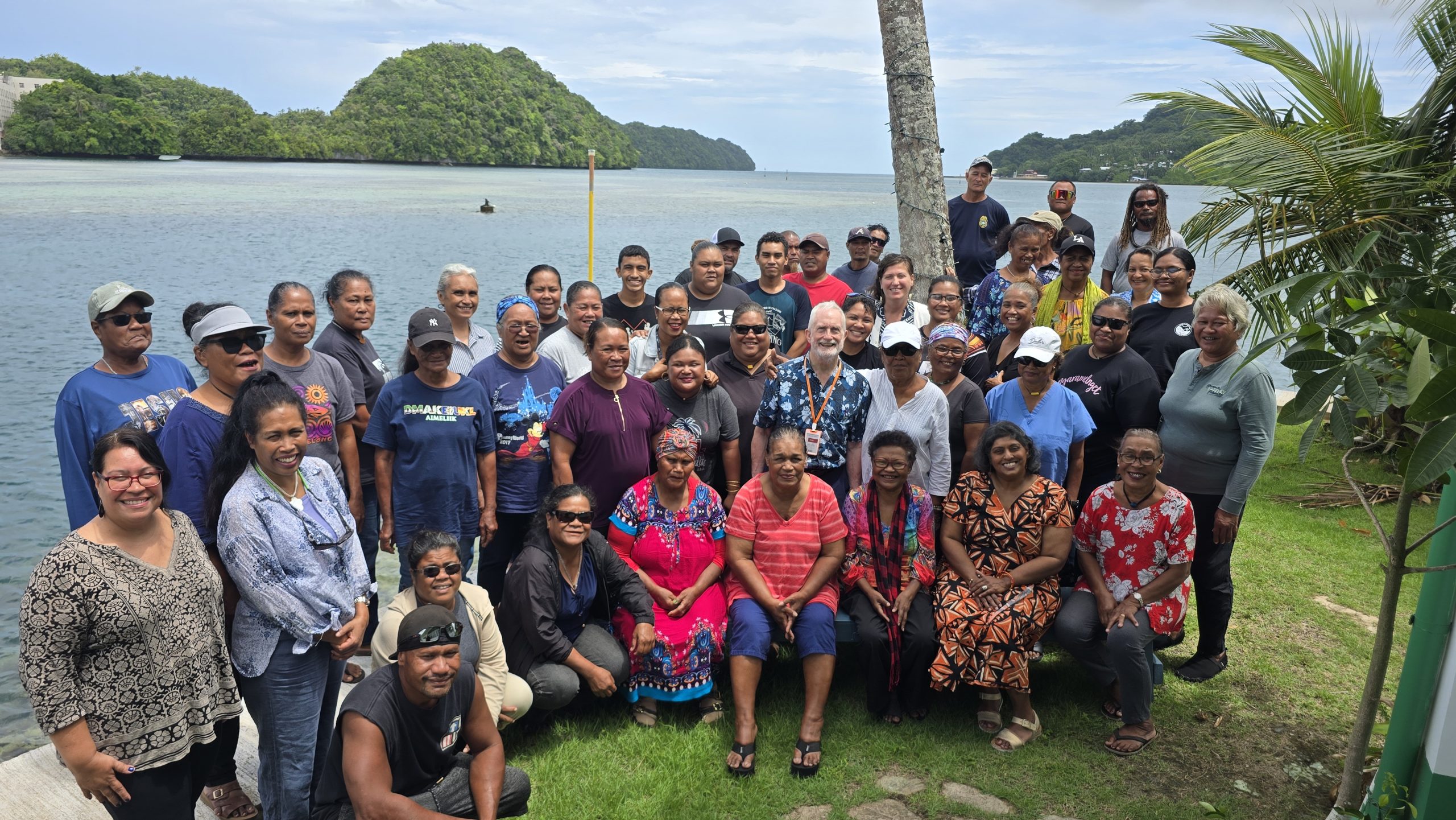
The gathering, themed “Real Talk: Building an Industry, Not Just Projects,” was framed not as a celebration of completion but as the beginning of something longer. Stakeholders from government, the private sector, farming communities, and international partners gathered to take stock of what worked, what did not, and what comes next.
THE ROAD AHEAD — AND A LEGAL URGENCY
Even as the hatchery stands and the seedlings multiply, a significant legal cloud remains. Palau is a signatory to CITES — the Convention on International Trade in Endangered Species — but has not passed the implementing legislation required under the convention since joining in the 1990s. Palau currently appears on what Holm described as a “not doing a good job” list on the CITES website.
Without that legislation formally establishing a management authority and a scientific authority, Palau risks sanctions that could block all exports — not just of giant clams, but of any CITES-listed species. The consequences for a nascent aquaculture export industry would be severe.
“If we don’t follow the rules, CITES can tell all countries not to accept any exports from Palau,” Holm warned. “This would be devastating to not just the giant clam industry, but aquaculture as a whole.” She expressed hope that ongoing dialogue with the Olbiil Era Kelulau, Palau’s national congress, would result in passage of the necessary legislation. Delegate Soalablai was in attendance at Wednesday’s event.
A LEGACY, NOT A PROJECT
As the learning exchange concluded, the message from all quarters was consistent: the Manaaki Project ends, but the work does not. Funding cycles close; industries do not.
“The legacy is for you now to take forward,” Ndebele told the Palauan partners. “It’s for you now to build the next future of what happens.”
For PAA, that means continuing to grow its membership, broker market connections, and advocate in policy circles for the regulatory environment the industry needs. For the Watson and Sons hatchery, it means scaling up seedling production and potentially hosting training for future satellite operators. For the women clam farmers of Ngarchelong, Ngaraard, and the other four communities, it means tending their ocean plots in the hope that the market catches up with their effort.
And for Palau, it means reckoning once more with a question the islands have faced before: whether the country that taught the world to farm giant clams can finally build a lasting industry from that knowledge.
The golden goose, if it exists, is in the water. The question is whether Palau can tend it.