


Overview:
COP31 in Antalya, Turkiye, ended without adopting a final cover decision after Pacific island nations firmly rejected a draft deal that excluded critical regional priorities. Among the major sticking points were the removal of commitments to phase out fossil fuels, the deletion of references to the International Court of Justice's Advisory Opinion, and the exclusion of the Pacific Resilience Facility and concrete adaptation finance guarantees.
By Elilai Rengiil
ANTALYA, Turkiye — COP31, the longest COP in history, ended on Sunday evening without a cover decision after countries failed to reach consensus. Pacific nations refused to back a text that dropped their key priorities, including any commitment to phase out fossil fuels.
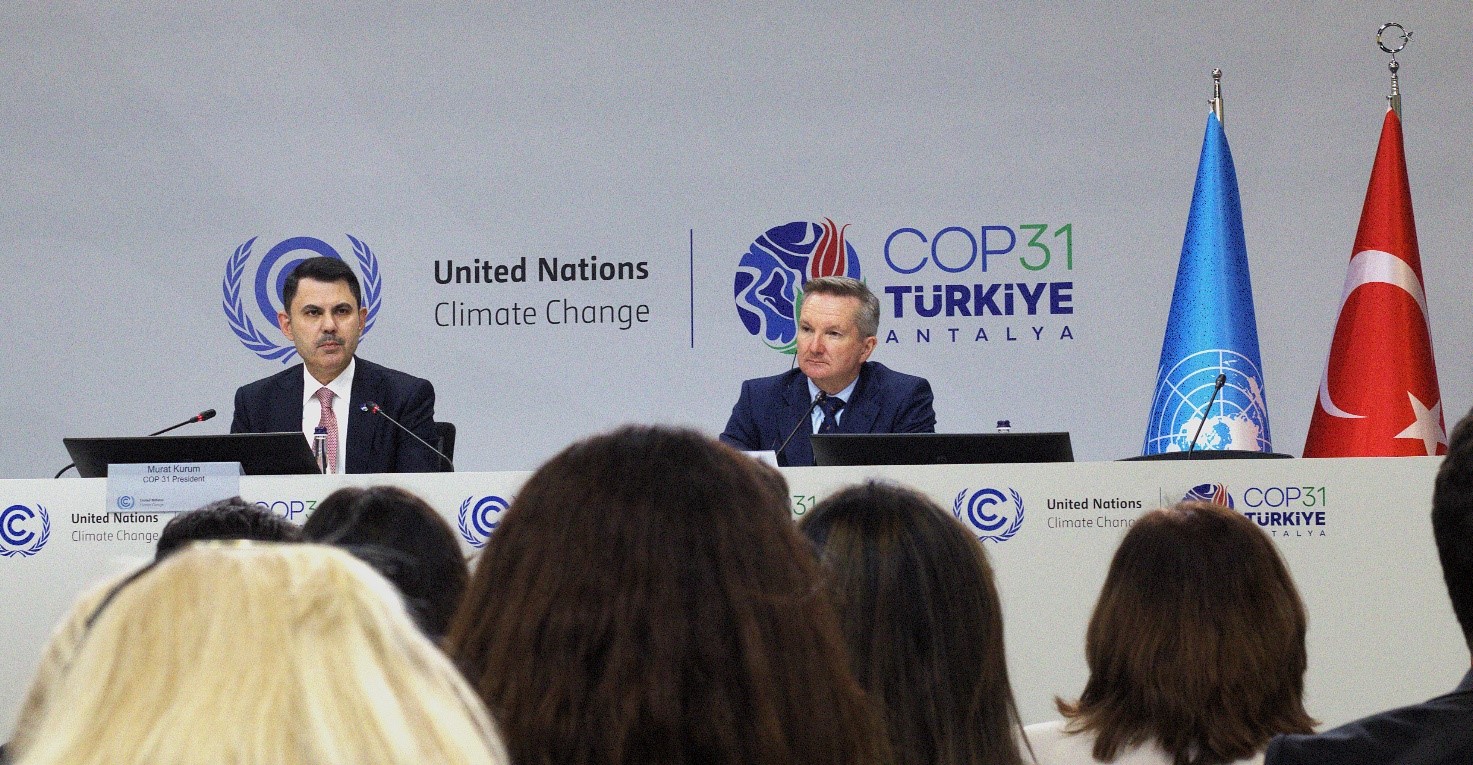
More than 130 countries, including multiple Pacific countries, called for a fossil fuel phase-out to be included in the summit’s cover decision, the Antalya Declaration. Neither the COP31 President Murat Kurum nor President of Negotiations Chris Bowen, who co-presided over the talks, delivered it.
For the Pacific, the final draft removed several of the region’s top priorities. The first draft referred to the International Court of Justice’s (ICJ) Advisory Opinion on climate change, which confirmed that states have legal obligations to prevent climate harm. That reference was removed.
References to the Pacific Resilience Facility (PRF), a regional fund to help communities prepare for and recover from climate disasters, were also removed.
On finance, it kept the commitment to at least triple adaptation finance by 2035 under the new global climate finance goal and launched an “Antalya-Addis Ababa road map” on adaptation and resilience finance. It also set talks on a plan to deliver that tripling for COP32.
While, the final draft stressed that developing countries, especially least developed countries (LDCs) and small island states (SIDS), need grants and low-interest loans, it dropped key financing details from the first draft.
These included a $120 billion minimum for adaptation finance and a reference to Oxfam’s method of calculating the baseline of tripling adaptation finance. Oxfam’s grant-equivalent method counts only the real value of finance to recipients, not the full-face value of loans that must be repaid.
Adaptation finance pays for crucial measures in the Pacific such as sea walls, water security, and climate-resilient crops.
The Marshall Islands, Vanuatu and Solomon Islands were among the Pacific nations that opposed the cover decision.
Additionally, Fiji objected to the text’s language on carbon capture, utilization and storage (CCUS). It warned the technology could prolong fossil fuel use and oil production instead of cutting emissions.
Before the closing plenary, Fiji’s climate minister and current Pacific Small Islands Developing States (PSIDS) Chair, Lynda Tabuya, drew a clear line.
“If we don’t get what we are asking for to acknowledge a transition away from fossil fuel, then they need to remove the specific reference to CCUS in the text as well,” she said.
She warned that if major emitters refused to move, Pacific nations would formally reject the decision.
Tuvalu’s Minister for Climate Change and Environment, Dr Maina Vakafua Talia, had already rebooked his flights to stay through overtime. He rejected suggestions that the talks were following a familiar pattern.
“You might say, ‘We have been here before.’ But have we?” Talia asked. “Have we been here, beyond the 1.5°C safety limit in the territory of overshoot? Have we been beyond the tropical coral reef tipping point?”
Citing the latest UNEP Emissions Gap Report, which projects 2.8 degrees Celsius of warming under current policies, Talia said fossil fuels could not be left out.
“We’re talking about the root cause of all of this. If we cannot address the fossil fuel crisis, then we are wasting our time here,” he said.
The Alliance of Small Island States (AOSIS), currently chaired by Palau, said the proposed decision fell short.
“We did not come all this way, and we have not stayed all this time, simply to endorse another set of promises that fall short of the scale of the crisis before us,” the group said in a statement.
AOSIS said the text did not set a path to limit how far and how long warming goes above 1.5 degrees, then bring it back below. It also said the text failed to give enough assurance that the needed finance and support would come.
“Therefore, many in our group were unable to adopt it,” the statement said.
AOSIS said any credible plan to deal with overshoot must include a transition away from fossil fuels, as agreed in Dubai, with faster cuts to methane emissions. It also called for a process to triple adaptation finance by 2035 and electrification powered by clean energy.
The bloc wanted the IPCC recognized as the best available science, with a set date for its seventh assessment reports. It also asked for equal weight for work on oceans and mountains, and recognition of the ICJ AO. The group said none of these appeared in the text with the clarity and completeness required.
Speaking at a press conference on November 22, Bowen said the summit had taken place in “the most complicated and fraught geopolitical environment in living memory.”
“I still believe multilateralism matters, and I still believe good things … happened at this COP. It just would have been good to have some more of them,” he said.
Bowen said he had met Pacific ministers many times each day. He said that despite the “disappointing plenary session,” COP31 had elevated Pacific issues “in a way which is sustained.” He said delegates still spoke to him about the pre-COP meeting in Tuvalu and what it showed them about climate impacts on low-lying island nations.
He said he was proud of the work on oceans. That work is not reflected in an adopted decision, but Bowen said “the words are there and will inform the process going forward.”
For the Pacific, the 1.5-degree limit is about survival. The region has long led the global call to hold warming to 1.5 degrees above pre-industrial levels, and its communities are already feeling the impacts. While COP31 was taking place, Fiji and Tonga both declared states of emergency because of the super El Niño.
AOSIS said the work is not over. It wants the tripling of adaptation finance backed by a realistic delivery plan, along with better access to climate finance and continued work on oceans.
The group called for results by the end of 2027. It said it would “marshal all of its strength” to support the current and incoming COP presidencies to reach that goal.
For many Pacific negotiators, COP31, which was promoted as a “Blue COP” and an “Implementation COP”, ended as the Truth COP. Ten years after the Paris Agreement, the science is clear, and so is the record: developed countries have not shown the political will or ambition needed to keep the 1.5-degree goal within reach or to deliver the climate finance they promised. Pacific nations now take that unfinished work to COP32 in Addis Ababa, Ethiopia, next November, where talks on tripling adaptation finance, elevating the ocean-climate nexus, and managing overshoot are due to resume.