


Overview:
Discover how climate change is causing irreversible non-economic losses in the Pacific—from vanishing ancestral food traditions to disrupted education for girls—and how the International Court of Justice’s climate advisory opinion could reshape government accountability.
By Elilai Rengiil
In parts of Solomon Islands, saltwater intrusion has made it impossible to grow the wild yam and taro once exchanged at weddings, according to a new Pacific climate report. In some communities, the custom has stopped.
The loss illustrates non-economic loss and damage (NELD) in the Pacific: harm to health, culture, identity, and other aspects of life that cannot be fully measured in money.
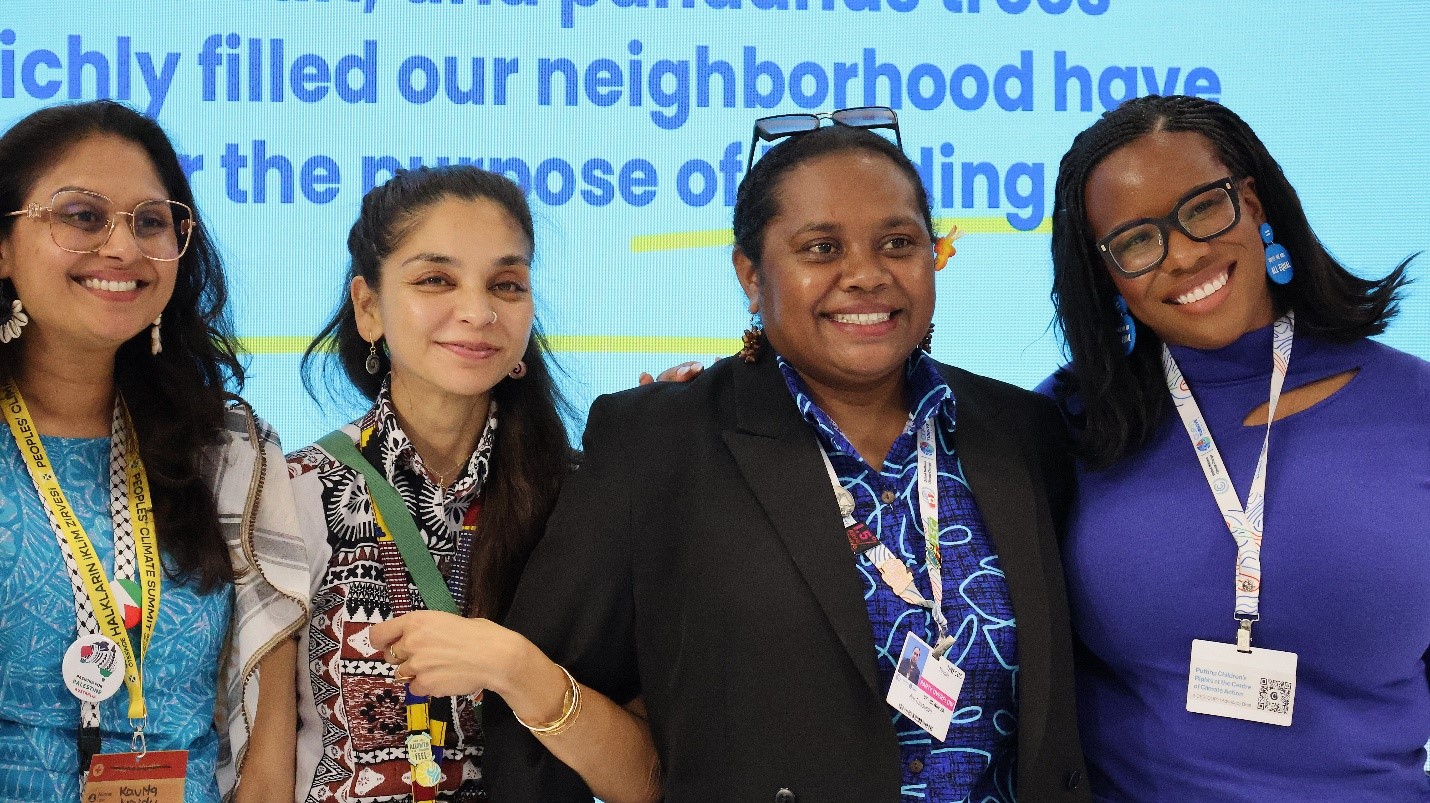
At a COP31 side event on November 17 at the Moana Blue Pacific Pavilion, panelists discussed how the intersecting impacts of climate change loss and damage affect Pacific women and girls and how the International Court of Justice’s (ICJ) climate advisory opinion (AO) could help advocates hold governments accountable.
The 180-page report from the Secretariat of the Pacific Regional Environment Programme (SPREP) also documents concerns in Vanuatu. Some communities fear losing part of their identity and standing if they can no longer grow the yam varieties that connect them to their ancestral lands.
One tribal leader quoted in the report said, “[If] The situation keeps on escalating, then I will definitely lose my identity as a tribe of the yam, because people will not be regarding my tribe anymore and disrespecting us.”
What girls are losing
International human rights lawyer Kavita Naidu presented findings from Plan International Australia’s Pacific Girls in a Changing Climate study. It surveyed more than 300 girls and young women aged 10 to 18 in Fiji, Kiribati, Solomon Islands, Tonga, Tuvalu and the Federated States of Micronesia.
Nearly all respondents reported harm to their health. About half said climate events had disrupted their schooling, and about half reported a lack of clean water. Respondents also described food shortages, difficulties maintaining hygiene and gender-based violence during or after disasters. In Tuvalu, 74% of respondents said they had missed school because of climate events.
Dr. Sindra Sharma, international policy lead for the Pacific Islands Climate Action Network (PICAN), said a separate, ongoing study had gathered about 1,500 excerpts on non-economic loss and damage from 47 focus groups in Fiji, Solomon Islands, Papua New Guinea and Kiribati.
“The sea crashed into the shores destroying the houses along the shore, the salt from the sea was blown into our trees resulting in the trees and plants to dry out and die… Many buildings fell off, people went hungry, and some schools had to be closed for this reason,” read one of the study excerpts being displayed during the panel.
What the court’s opinion means
Ani Tuisausau, youth engagement officer for Pacific Islands Students Fighting Climate Change (PISFCC), said her 9-year-old was already talking about El Niño. She wondered what questions her child would be asking in another decade.
The PISFCC led the campaign, supported by the government of Vanuatu, which resulted in the unanimous ICJ AO on July 23, 2025, clarifying states’ legal obligations on climate change and human rights.
“This is about losing everything that is linked to me, to my identity, ancestral lands, homes, our heritage,” Tuisausau said. “Even knowledge about our own places, places that whole generations of identity belong to.”
Tuisausau said the ICJ AO gives Pacific advocates a basis to ask governments what they are doing to meet their climate obligations. She said a U.N. General Assembly report expected in 2027 should show how countries are cutting emissions, preventing further harm and addressing activities that contribute to climate change.
The ICJ AO says a country can bear international responsibility if it breaches its climate obligations. It may be required to end an ongoing breach.
Where the applicable legal conditions are met, it may also have to give assurances that the breach will not recur or make full reparation for the harm it caused. That can include restoring what was lost where possible or paying compensation.
The Pacific has pushed for the ICJ AO to be include in the COP texts, and it was finally included this COP in the draft cover text released on November 16.
The draft text welcomed the ICJ AO in Paragraph 120 and noted U.N. General Assembly Resolution 80/263. The resolution stresses the importance of governments taking action under the Paris Agreement to limit warming to 1.5°C above pre-industrial levels.
Tuisausau said compensation could not bring back a lost ancestral site or recover traditional knowledge. But the fact that those losses could not be undone, she said, did not excuse governments from recognizing them or meeting their responsibilities.