


Overview:
The Youth Negotiators Academy has launched the Ocean Youth Negotiator Program to empower young delegates from the Pacific and beyond for international marine discussions, including the upcoming High Seas Treaty COP.
By Elilai Rengiil
ANTALYA, Türkiye — The Youth Negotiators Academy (YNA) has launched an ocean-focused training program to prepare young delegates for international ocean discussions and help the Pacific, and other regions, delegations build negotiating capacity.
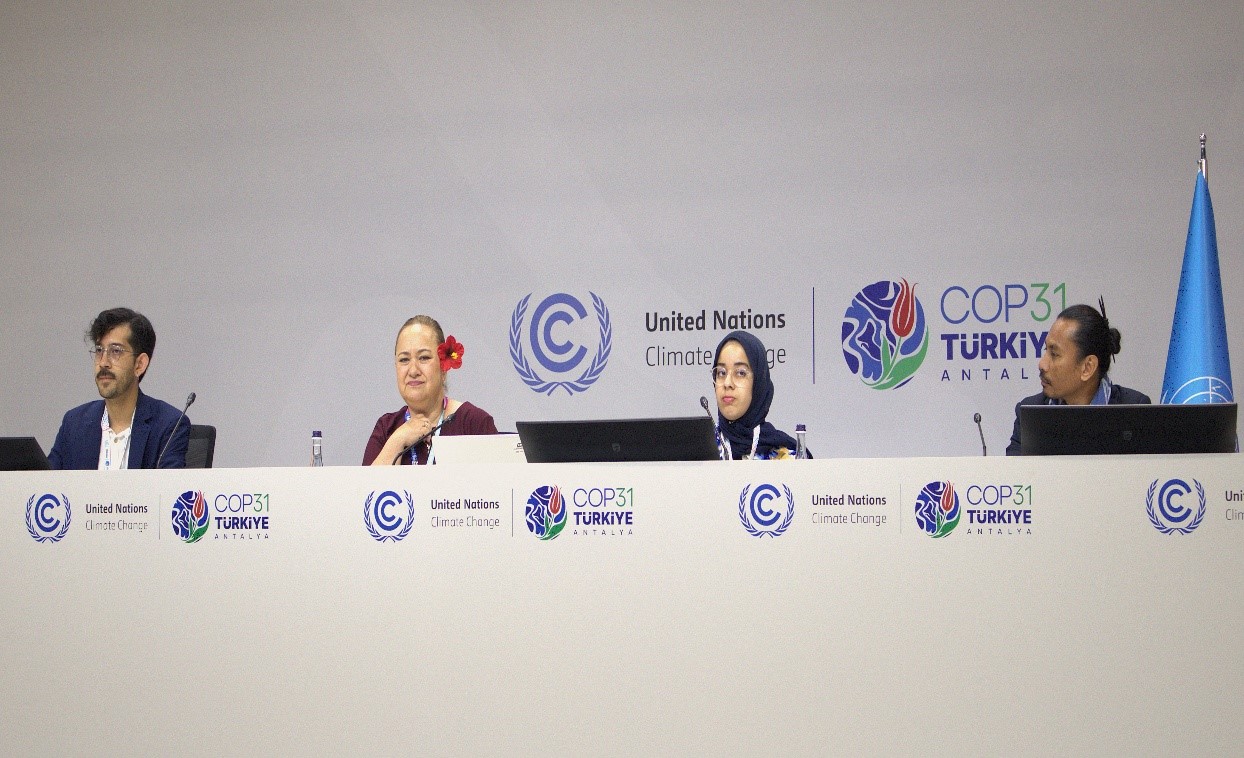
Announced at the YNA and Palau hosted COP31 side-event on November 16, the launch of the Ocean Youth Negotiator Program expands the academy’s training beyond biodiversity, land, and climate.
It will prepare participants to engage in the first Conference of the Parties to the High Seas Treaty, youth negotiator Emmanuel Caras Prado said.
The launch comes as governments at COP31 debate proposals on moving away from fossil fuels and limiting the scale and duration of warming beyond the 1.5-degree Celsius goal, a goal that has been a key priority for the Pacific.
The Arab Group has opposed global targets directed at particular sectors or energy sources, underscoring divisions over the wording of a possible outcome.
Toni Soalablai, a graduate of the academy’s climate program who now works with Palau’s Office of Climate Change, said the training helped her understand how individual words can shape those negotiations.
“English is something we use every day, but in these rooms, the choice of a single word can change the meaning of an entire paragraph,” she said.
The benefits for Palau, she said, include a network of peers who can help delegates navigate technical discussions and competing demands.
“And for Palau especially, where our delegation is small and we’re often covering multiple thematic areas, having that network makes a huge difference,” Soalablai said. “All of Palau’s CYNP alumni are now actively negotiating, and I think that’s a really good reflection of what happens when young people are given the right training and support.”
The ocean program brings that capacity-building approach to another negotiating process closely connected to Pacific climate concerns.
The ocean absorbs substantial amounts of human-caused carbon dioxide and excess heat, while warming, acidification and rising seas threaten marine ecosystems and coastal communities. The relationship makes ocean protection and emissions reductions connected priorities.
“It’s the biggest carbon sink, and when it comes to solutions to climate change, the oceans have a lot to offer,” said Pacific Climate Envoy for Oceans Inia Seruiratu.
The new program will prepare young negotiators to participate as the High Seas Treaty moves into implementation.
“We are very excited because it’s the first COP and we will be involved from the beginning,” Prado said. “I think it will be meaningful to see how we can influence the agenda.”
Formally known as the Biodiversity Beyond National Jurisdiction Agreement (BBNJ), the treaty entered into force in January 2026. Its first COP is scheduled for January 11-22, 2027, at United Nations headquarters in New York.
The agreement provides a framework for conserving and sustainably using marine biodiversity beyond national jurisdiction.
It covers marine protected areas, environmental impact assessments, benefits from marine genetic resources, and capacity-building and marine technology transfer.
Palau’s lead climate change negotiator, Xavier Erbai Matsutaro, said the country joined the academy’s climate program to strengthen a delegation that initially had only three to five people covering the talks.
Training young delegates combines fresh perspectives with experienced negotiators’ knowledge while building capacity for the years ahead, he said.
Matsutaro pointed to Kenley Kenneth, who attended the Climate Youth Negotiators Program, joined Palau’s Office of Climate Change and developed expertise in loss and damage. Kenneth now works with the Secretariat of the Pacific Regional Environment Programme, supporting the region.
“In fact, he’s in a different room providing talking points for our community,” Matsutaro said.
Youth from 14 Pacific countries have participated in the academy since its launch in 2022.
SPREP Director of Climate Change Tagaloa Cooper said the Climate Change Negotiators Program helped participants build confidence and international networks while preparing them to succeed experienced delegates.
“It is actually a succession program,” Cooper said.
She said SPREP would continue supporting the program, having seen young participants grow into negotiating roles.
Prado said intergenerational equity required more than asking young people for their views.
“We actually are building the future,” he said.