


Overview:
A 1981 painting by Palauan artist Samuel Adelbai became the centerpiece of this year’s DAVE Art Show, offering a striking vision of a future Palau shaped by tradition, modernization and global events.
By: L.N. Reklai
KOROR, Palau (Oct.1, 2026)— “Belau ra Klukuk, Belau er Kid,” translated as “Belau of Tomorrow, Our Belau,” took on special meaning at this year’s DAVE Art Show, where a 1981 painting by Palauan artist Samuel Adelbai served as the exhibition’s centerpiece.
Adelbai’s “Bai er Belau” offered a striking vision of what Palau’s future might look like, using one of the most recognizable symbols of Palauan culture — the traditional bai, or men’s meeting house — as its frame.

Painted in the early 1980s, when Palau and Micronesia were debating their future political status and transition from the U.S. Trust Territory system, the work captured a society looking toward an uncertain future.
More than four decades later, the painting remains open to interpretation and closely reflects the theme of this year’s exhibition: a Palau shaped by its past while moving toward an increasingly modern world.
The painting resembles a traditional bai, but its details depart from the customary images associated with the structures.

Cars, buses, speedboats and Pepsi-Cola appear as motifs on the walls. Rather than focusing only on traditional tribal conflicts and events, the stories depicted on the bai include nuclear bombs, World War II and other modern global conflicts.
The result is a visual record of a Palau that Adelbai imagined would become increasingly Westernized, with its history influenced not only by local events but also by conflicts and changes taking place around the world.
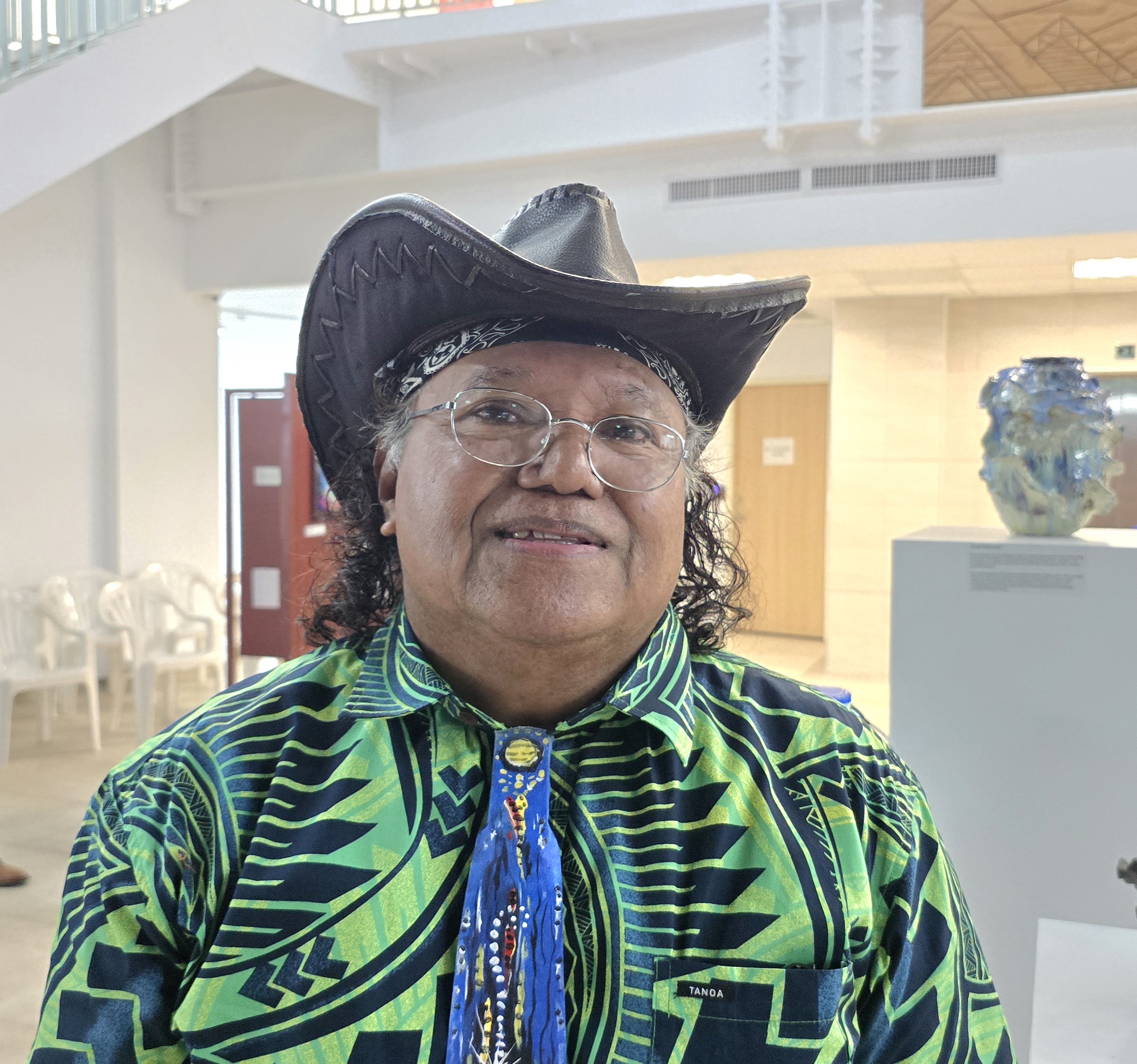
Adelbai, who attended the Sept. 29 viewing reception, discussed the work and some of the ideas behind his vision of Palau’s future.
According to Faustina Rehuher-Marrugg, former head of the Belau National Museum, the painting was taken to the United Nations General Assembly in 1981, where its imagery generated controversy because of what it appeared to communicate about Palau’s future.
The use of the bai was particularly significant.
Traditional Palauan bai serve not only as meeting places but also as repositories of history and cultural knowledge. Their paintings communicate the ideals, values, norms and morals of a community.
Paintings on the exterior traditionally reflect the values and standards of the society, while paintings inside the bai, particularly on the cables, depict legends and stories passed down by the people of the village.
Adelbai’s painting used that traditional visual language to tell a different kind of story — one about a Palau entering a changing world.
Like a time capsule captured in a frame, “Bai er Belau” presents the future as imagined in 1981 while also preserving the concerns and expectations of that period.
Its meaning can change depending on who is viewing it and when. That quality of timelessness and multiple interpretations is one of the characteristics of a lasting work of art.
For the DAVE Art Show, “Bai er Belau” provided a fitting centerpiece for “Belau ra Klukuk, Belau er Kid,” connecting Palau’s cultural past with questions about its future.
The presentation was made possible through Create Belau’s annual DAVE Art Show, an exhibition honoring the late Dave Ngirailemesang, described as one of Palau’s “most revered and prolific artists.”
DAVE stands for Display of Art and Visual Expressions. The annual exhibition features works by artists in Palau and members of the Palauan artistic community in the diaspora.
This year’s Independence Day exhibition featured a range of artistic mediums, including oil paintings, photographs, illustrations and sculptures.
The private exhibition and viewing reception on Sept. 29 also included a culinary display, adding taste and smell to the visual experience.
Mr. Mutok, representing the event’s co-host, the Ministry of Human Resources, Culture, Tourism & Development, said artists play an important role in preserving and communicating Palau’s identity.
The work of artists, he said, is a “way of telling our stories, preserving our traditions and expressing who we are and connecting generations.”
“By supporting local artists, we help ensure that Palauan creativity and cultural heritage continue to grow and be appreciated both at home and beyond our shores,” he said.