


Overview:
**A warning — and a roadmap.** A new United Nations report launched in Palau during the 55th Pacific Islands Forum Leaders Meeting says sea-level rise is accelerating, threatening communities, economies, cultures and national sovereignty. But the report does more than document the crisis: It lays out practical solutions, from faster emissions cuts and stronger climate finance to coastal protection, resilient infrastructure and rights-based relocation.
By: L.N. Reklai
KOROR, Palau — “They should not be asked to surrender their land or their future because others failed to cut their emissions.”
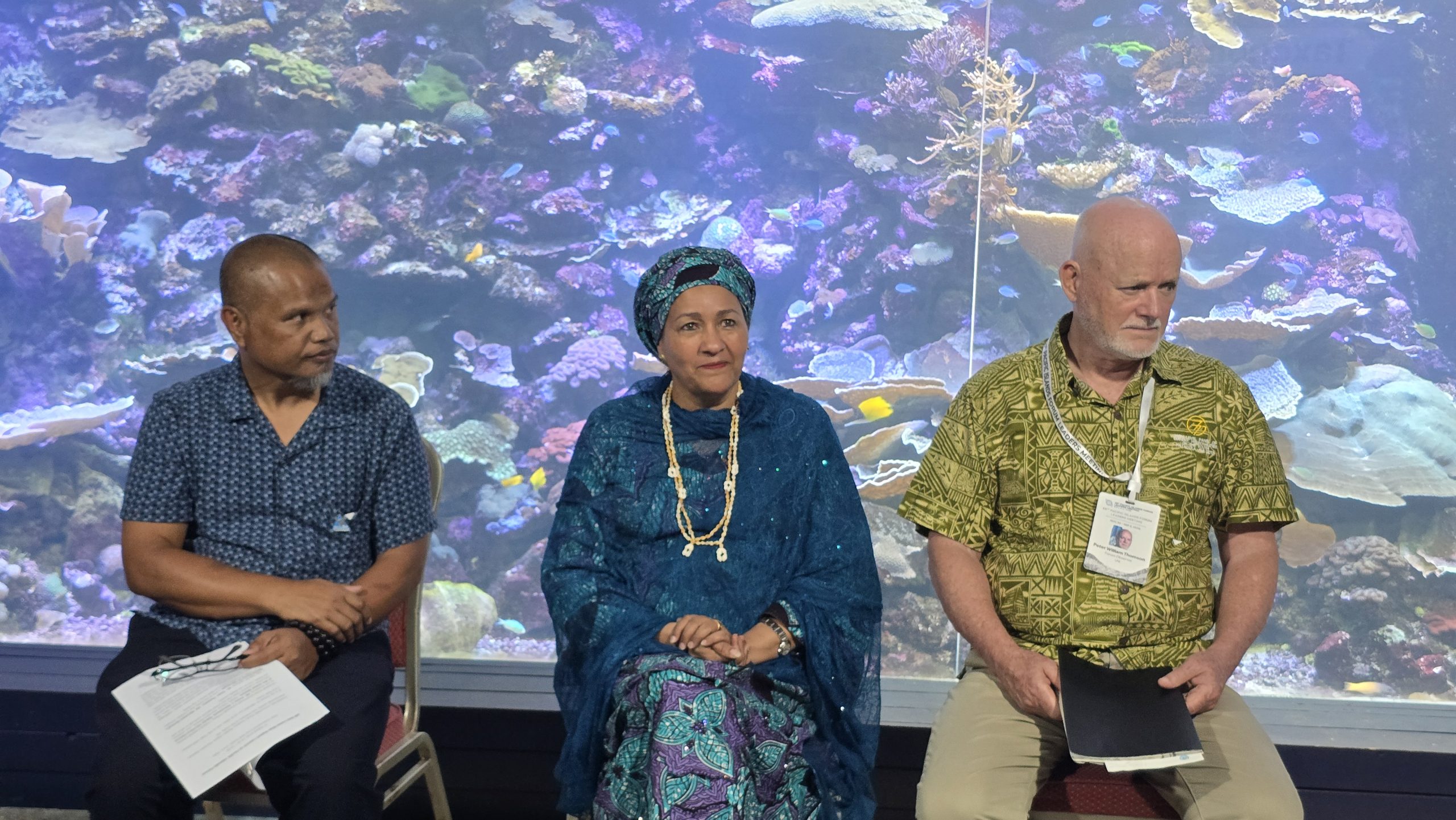
That message from United Nations Deputy Secretary-General Amina Mohammed resonated strongly in Palau on Aug. 31 as the United Nations launched its report on sea-level rise at the Palau International Coral Reef Center during the 55th Pacific Islands Forum Leaders Meeting.
The report, “Challenges Related to Sea Level Rise and Ways and Approaches to Address Them,” examines what rising seas mean not only for the environment, but also for people, communities, economies, culture, human rights and the future of countries whose lands are increasingly vulnerable.
For Palau and other Pacific island nations, the issue is already part of everyday life.
Mohammed pointed to taro patches and freshwater supplies being affected by saltwater intrusion and cited experiences in Palau’s Melekok and Ngeremlengui, where saltwater inundation has damaged homes and land and prompted some residents to move to safer areas.
“That is what sea level rise looks like today,” Mohammed said.
The numbers in the report show why the concern is growing.
Global sea level rose at an average rate of about 4.7 millimeters per year from 2014 to 2023, followed by a record increase of 5.9 millimeters in 2024. Even under very low emissions, global mean sea level is projected to rise about 0.23 meters by 2050 compared with 1995-2014 levels.
The report also estimates that nearly 770 million people worldwide — about one in 10 people — live in coastal areas less than five meters above the high-tide line. Pacific island states have experienced relative sea-level rise at more than twice the global average over the past three decades.
For Palau, those projections translate into concerns about freshwater, food security, infrastructure, homes, tourism, fisheries and cultural heritage.
Palau Minister of Agriculture, Fisheries and the Environment Steven Victor said the country has been experiencing the impacts while continuing to adapt.
“Sea level rise is upon us, and we must confront it with urgency,” Victor said, noting that rising seas are reaching Palau’s shorelines, taro plots and freshwater and threatening infrastructure, food security, cultural heritage and ancestral resting places.
“For us, this is not only an environmental question. It is a question of law, of culture, of our sovereignty, and our identity as ocean people,” he said.
The report makes clear that the effects are interconnected. Rising seas can cause flooding and erosion, contaminate wells and agricultural land with saltwater, damage roads and energy systems, disrupt ports and supply chains and increase pressure on health and sanitation systems.
Tourism, fisheries and aquaculture are also vulnerable, while the loss of ancestral lands and heritage sites can affect cultural identity and traditional knowledge.
For Palau, one of the most important aspects of the report is that it does not stop at describing the problem. It provides a range of approaches governments and communities can use to prepare and respond.
The report calls for faster reductions in greenhouse gas emissions while urging countries to incorporate sea-level rise into national development plans, infrastructure design, land-use decisions, water and food security planning and disaster-risk strategies.
It also recommends practical adaptation measures, including coastal defenses, drainage and flood-control systems, resilient infrastructure, mangrove, reef and wetland restoration, zoning reforms, community-based adaptation and social protection. Where relocation becomes unavoidable, it calls for planning that protects land rights, livelihoods, culture and community participation.
Better information and early warnings are also part of the solution. The report recommends combining satellite observations and scientific modeling with local measurements, geospatial tools and Indigenous and traditional knowledge.
But implementing those solutions requires money — an issue repeatedly raised at the Palau launch.
The report estimates developing countries need between $310 billion and $365 billion annually for climate adaptation, compared with an estimated $26 billion in adaptation finance in 2023. It recommends greater access to grants and highly concessional financing, particularly for small island developing states facing limited resources and heavy debt burdens.
United Nations Special Envoy for the Ocean Peter Thomson said the report could help change the conversation around climate financing because it identifies specific approaches that can be supported.
“We’ve identified the problem, but there has never been a report that says, ‘Here is a list of viable solutions that we can propose,’” Thomson said.
For Palau, financing is critical because adaptation has limits.
Victor said Pacific communities have adapted for generations, but the pace and intensity of climate impacts may eventually exceed their ability to cope without outside support.
“We all are capable of adapting,” Victor said, “but the frequency and the strength of the challenge that we’re facing” requires greater access to technology, finance and expertise.
The report also addresses one of the most consequential questions for Palau and other Pacific island states: What happens to sovereignty and maritime rights if sea-level rise causes land to become uninhabitable or submerged?
It calls for greater legal stability concerning statehood, sovereignty, maritime zones and boundaries, including support for the principle that statehood should continue once established even if territory is severely degraded or submerged. It also says solutions involving maritime zones and boundaries should remain consistent with the U.N. Convention on the Law of the Sea.
Victor said Palau will continue to defend its maritime boundaries, even in the face of potential loss of land.
“Our position has been, and will continue to be, and we will fight to keep our maritime boundaries whether we lose any part of the land,” he said.
The report comes at a critical time for the Pacific. A U.N. General Assembly high-level meeting on sea-level rise is scheduled for Sept. 24, where countries are expected to adopt a political declaration on the issue.
Victor urged Pacific countries and their partners to maintain pressure for action.
“We do this not only for ourselves, but for our children and the generations who will inherit these islands and the planet,” he said.
“The Pacific will continue to lead, and we ask the world to stand with us.”
For Palau, the report provides both a stark assessment of the risks ahead and a potential roadmap for responding to them — reinforcing the country’s longstanding call for the world to reduce emissions while helping vulnerable island communities protect the land, waters, culture and future they are working to preserve.