


Overview:
For thousands of years, Pacific navigators crossed vast stretches of ocean guided by stars, swells, winds, birds and currents — long before GPS or electronic charts existed. Now, traditional voyaging leaders are asking the Pacific Islands Forum to help ensure that knowledge remains alive for generations to come.
By: L.N. Reklai
KOROR, Palau — “Although we are many nations, we remain one ocean people.”
That message from Grand Master Navigator Ali Haleyalur captures the central argument behind a declaration urging Pacific leaders to recognize traditional navigation as a living cultural heritage of the Blue Pacific continent and make its preservation a regional priority.

Presented by the Micronesian Voyaging Society and the Palau Council of Chiefs for consideration by the 55th Pacific Islands Forum Leaders Meeting, the declaration seeks to place traditional navigation within the broader regional policy framework of the 2050 Strategy for the Blue Pacific Continent.
For Pacific peoples, traditional navigation is more than the ability to travel between islands. It represents a sophisticated body of indigenous knowledge, a source of cultural identity and a reminder that the ocean has historically connected rather than divided the region.
“Our ancestors never believed they lived on isolated islands,” Haleyalur said. They understood the Pacific as a vast ocean continent connected by knowledge, family, trade, culture, respect and friendship.
For generations, Pacific navigators crossed enormous distances without compasses, GPS, radar or electronic charts. They learned to interpret the natural world, using stars as maps, the moon as a calendar and ocean swells as pathways. Clouds, birds, currents, wind, sea color, fish movements and even smells carried by the ocean could provide information about location and weather.
Haleyalur described that knowledge as science built through generations of careful observation.
“This was not guesswork,” he said. “It was astronomy. It was meteorology. It was oceanography. It was environmental science. It was mathematics.”
He said traditional navigation demonstrates the sophistication of indigenous knowledge systems and the intellectual achievements of Pacific peoples.
But the knowledge is increasingly at risk.
Shallum Etpison, president of the Micronesian Voyaging Society, said traditional navigation must be understood as an expression of Pacific identity rather than simply a historical sailing technique.
“Traditional navigation, however, is more than knowing how to sail from one island to another,” Etpison said. “It represents who we are as Pacific people.”
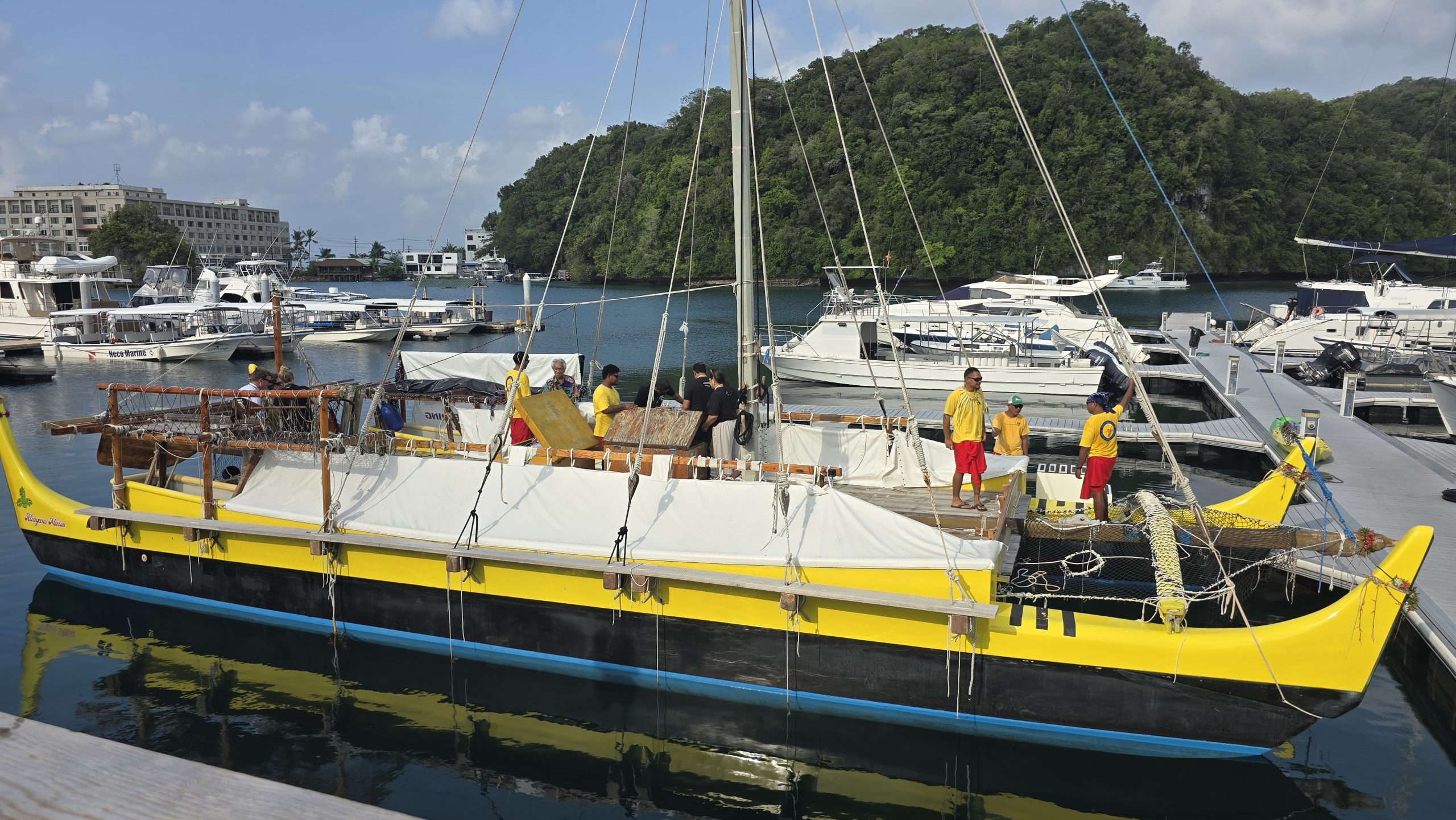
The Micronesian Voyaging Society has worked to keep the tradition alive through the traditional voyaging canoe Alingano Maisu, along with grand master navigators, elders and young crew members.
Yet Etpison warned that only a small number of master navigators still hold the complete body of knowledge passed down through generations. Without action, he said, knowledge that survived for thousands of years could disappear within a lifetime.
The proposed declaration seeks to address that risk through a regional approach.
It calls for traditional navigation and indigenous ocean knowledge to be incorporated into education, youth initiatives and cultural programs, while supporting intergenerational learning and mentorship between master navigators, elders and young people.
It also calls for governments and development partners to establish sustainable funding for traditional voyaging programs, canoe construction and restoration, cultural and language preservation, and community-based navigation schools across the Pacific.
The declaration further proposes development of a regional framework for protecting, promoting and transmitting traditional navigation and indigenous ocean knowledge in alignment with the 2050 Strategy for the Blue Pacific Continent.
That framework would connect cultural preservation with some of the region’s major policy priorities, including ocean stewardship, climate resilience, biodiversity and disaster preparedness.
For Haleyalur, traditional knowledge also offers lessons for confronting today’s environmental challenges.
“Our ancestors understood sustainability long before the word existed,” he said. They knew when to fish, harvest, travel and wait, and understood the balance between people and the natural world.
He argued that traditional knowledge and modern science should not be treated as competing systems.
“Modern science and traditional knowledge are not competitive,” Haleyalur said. “They are partners.”
Together, he said, they can contribute to climate resilience, marine conservation, sustainable fisheries, disaster preparedness and responsible stewardship of the Pacific Ocean.
The declaration also emphasizes that traditional navigation should be protected as a shared Pacific inheritance while respecting the ownership, custodianship and cultural protocols of indigenous communities.
It supports appropriate international recognition, including collaboration with UNESCO and other international organizations. But its immediate focus is regional: ensuring that Pacific governments and institutions have a framework and resources to keep the knowledge alive within Pacific communities.
At the heart of the proposal is the role of Pacific youth.
The declaration recognizes young people as essential to sustaining traditional navigation and calls for greater opportunities for them to learn directly from master navigators, traditional knowledge holders, canoe builders and cultural practitioners.
Haleyalur envisioned young navigators from across the Blue Pacific regularly gathering to learn from one another and traditional voyaging canoes once again crossing the ocean in friendship rather than competition.
Such efforts, he said, would demonstrate to young Pacific Islanders that their ancestral knowledge is valued and worthy of carrying forward.
“If we allow this knowledge to disappear, we lose more than a tradition,” Haleyalur said. “We lose an irreplaceable library of human wisdom.”
The declaration ultimately frames traditional navigation as a living expression of Pacific identity, resilience, innovation and unity — and as part of the region’s future rather than simply its past.
For Haleyalur, the significance extends beyond individual islands or nations.
“The bigger countries see us from the bird’s eye as specks of sand floating in the Pacific Ocean,” he said. “One thing they don’t know is that we are the keeper and the guardian of the biggest ocean on Earth.”
The proposed regional declaration asks Pacific leaders to recognize that responsibility and help ensure that the knowledge carried by generations of navigators — in memory, songs, stories, ceremonies and an understanding of the stars and ocean — continues to guide future generations.
As the declaration states, traditional navigation is “far more than the art of sailing.” It is a way of understanding who Pacific peoples are and how their ancestors remained connected across the world’s largest ocean.