


Overview:
Palau President and Pacific Islands Forum Chair Surangel Whipps Jr. is urging international partners to invest in Pacific renewable energy projects and help raise the Pacific Resilience Facility to its $500 million target to support climate adaptation in vulnerable communities.
By Elilai Rengiil
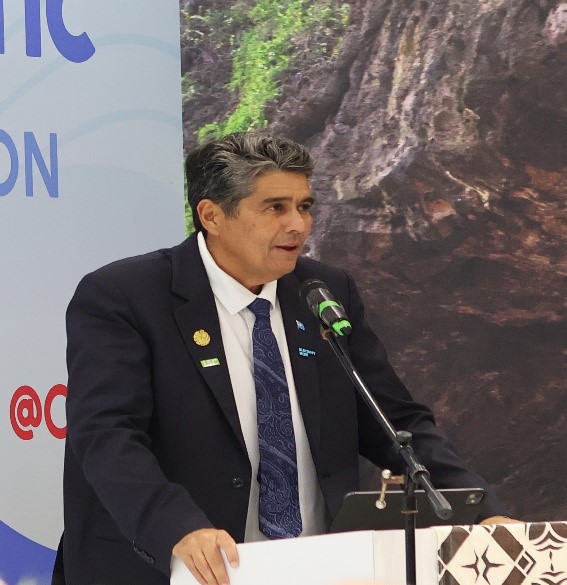
ANTALYA, Türkiye (Nov. 15, 2026) — Palau President and Pacific Islands Forum (PIF) Chair Surangel Whipps Jr. has urged partners at COP31 to finance Pacific renewable energy projects and help bring a regional resilience fund to its $500 million target.
Speaking to Pacific media on November 12, Whipps said Pacific countries had brought projects ready for investment and wanted commitments turned into action.
“We’ve come with the projects in the Pacific, ready to be financed,” he said. “We ask our partners to come and deliver. Act by investing.”
Whipps said keeping global warming within 1.5°C remained the region’s central demand.
In his statement to COP31 leaders, Whipps described warming beyond that threshold as an existential threat to Pacific food supplies, economies, and sovereignty.
He identified the Pacific Resilience Facility (PRF) as a way to get adaptation funding to communities that large multilateral banks and funds struggle to reach.
The PRF had around $200 million toward its $500 million initial capitalization target when Pacific leaders arrived in Antalya. Reaching the target would allow it to generate returns and provide community grants at full scale.
“We should not have to pay for our own survival, but we act without hesitation,” Whipps said.
The Pacific has made 46% of the contributions to the PRF so far, and called on governments, philanthropic partners, and multilateral funds to match that commitment.
Whipps said partners also needed to simplify access to funding, “Cut the red tape so that we can get the funds out there to help the communities adapt.”
For Palau, renewable investment also means addressing the practical limits of its electricity system. Whipps said the country’s utility had advised him that solar could supply perhaps 70% of its electricity, but could not meet all its needs alone.
He said countries needed to learn from one another and find partners to help put workable energy solutions in place. He also stressed that expanding electricity access must support renewable generation rather than coal and gas.
Whipps called for ocean financing to cover not only protection but also sustainable use and management, saying oceans remained too easily sidelined in climate negotiations.
Asked about fossil fuel interests, he said producers and emitters would continue to put up roadblocks, but that should not weaken Pacific resolve.
He raised court action as a possible response if countries failed to honor their climate commitments, while urging cooperation through investment and easier access to finance.
“Through the COP process, we’re saying partner with us,” Whipps said. “Help us solve these problems.”