


Overview:
What happens when climate change threatens not just where people live, but the meaning of home itself? At a Pacific Islands Forum side event in Palau, regional leaders and experts stressed that relocation should be a last resort — with the first priority being to help Pacific communities remain safely on their ancestral lands while protecting culture, identity and belonging.
By: Summer Kennard
KOROR, Palau (Sept. 2, 2026) As Pacific countries prepare for the possibility of climate-driven relocation, the region’s approach should not begin with moving people — but with finding ways for them to remain safely on their ancestral land.
That was the message from International Organization for Migration (IOM) Regional Director for Asia-Pacific Iori Kato during a Pacific Islands Forum side event on planned relocation and climate mobility.

“What makes the Pacific approach distinct is that it starts with the people, and not the location per se,” Kato said.
“Across the Pacific, the first objective is not to move communities. It is to help them stay where they are, safely and with dignity, if that is what they want.”
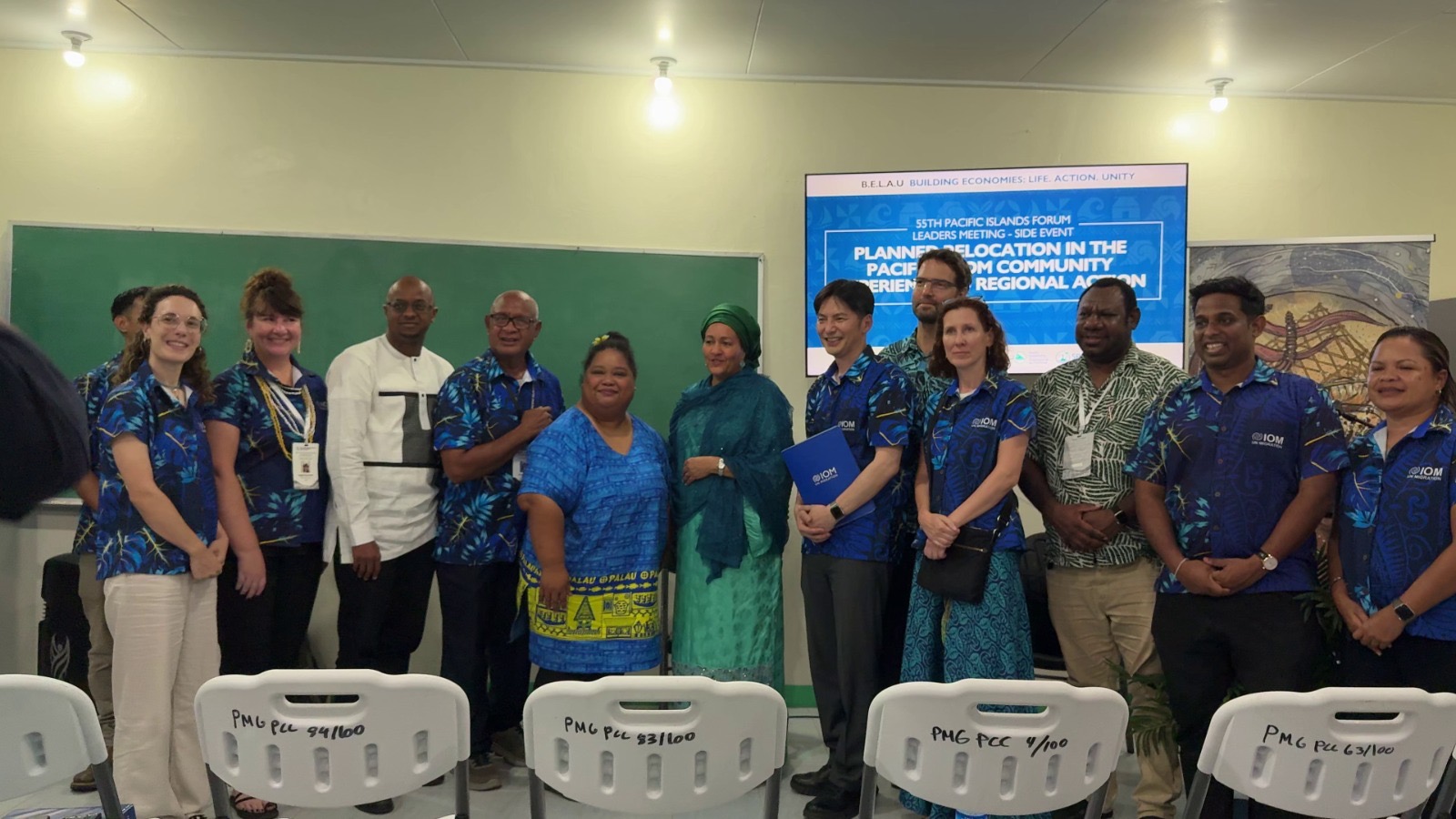
The comments came during the side event “Planned Relocation in the Pacific: From Community Experience to Regional Action,” which focused on putting the Pacific Regional Framework on Climate Mobility into practice.
Kato said relocation should only enter the conversation when other options have been exhausted, emphasizing that the success of relocation cannot simply be measured by the number of houses or infrastructure moved.
“It is measured by whether communities retain their social homes, cultural connections, livelihoods, and sense of belonging,” he said.
The issue is particularly significant for Palau, where land is closely connected to family, culture, identity, history and traditional systems of belonging.
Palau Deputy Climate Change Coordinator Joe Aitaro said climate mobility does not mean giving up on coastal communities.
“When we say climate mobility, we’re not giving up on living on the coast,” Aitaro said. “We want to stay.”
Aitaro said Palau’s experience has also shown the importance of working with trusted community organizations rather than relying solely on government-led approaches.
“Government is not always the right messenger,” he said, pointing to faith groups and civil society organizations as having stronger relationships with some communities.
The question of what happens to cultural identity if communities are eventually forced to move was also raised during the discussion.
As a journalist covering the session, I asked what panelists would tell a young Palauan or Pacific Islander who might face relocation in the future: How can they stay connected to home?
Aitaro urged young people to learn their language and culture and take an active role in shaping their future.
BANGO Secretary Tanya Rengulbai pointed to Tuvalu’s efforts to digitally preserve cultural heritage, including songs and other traditions, as one possible way future generations could maintain a connection to their origins even if they are no longer physically living on their islands.
For Kato, keeping those connections intact is at the heart of the Pacific approach.
“The communities themselves must lead the process, drawing on their lived experience, traditional knowledge, and aspirations for the future,” he said.
“The challenge now is implementation.”
The Pacific Regional Framework on Climate Mobility and its 2025–2030 Implementation Plan aim to translate these principles into practical action, with planned relocation treated as a people-centred, rights-based and culturally grounded option of last resort.