


Overview:
Pacific island nations are seeking more than $2 billion in investment for over 70 renewable energy projects across 14 countries. President Surangel Whipps Jr. says regional cooperation and private investment could help reduce reliance on costly diesel and accelerate the transition to clean energy.
By Elilai Rengiil
Palau President and Pacific Islands Forum (PIF) Chair Surangel Whipps Jr. has urged investors to help the Pacific become the world’s first region powered entirely by renewable energy, saying the shift could cut dependence on costly imported diesel.
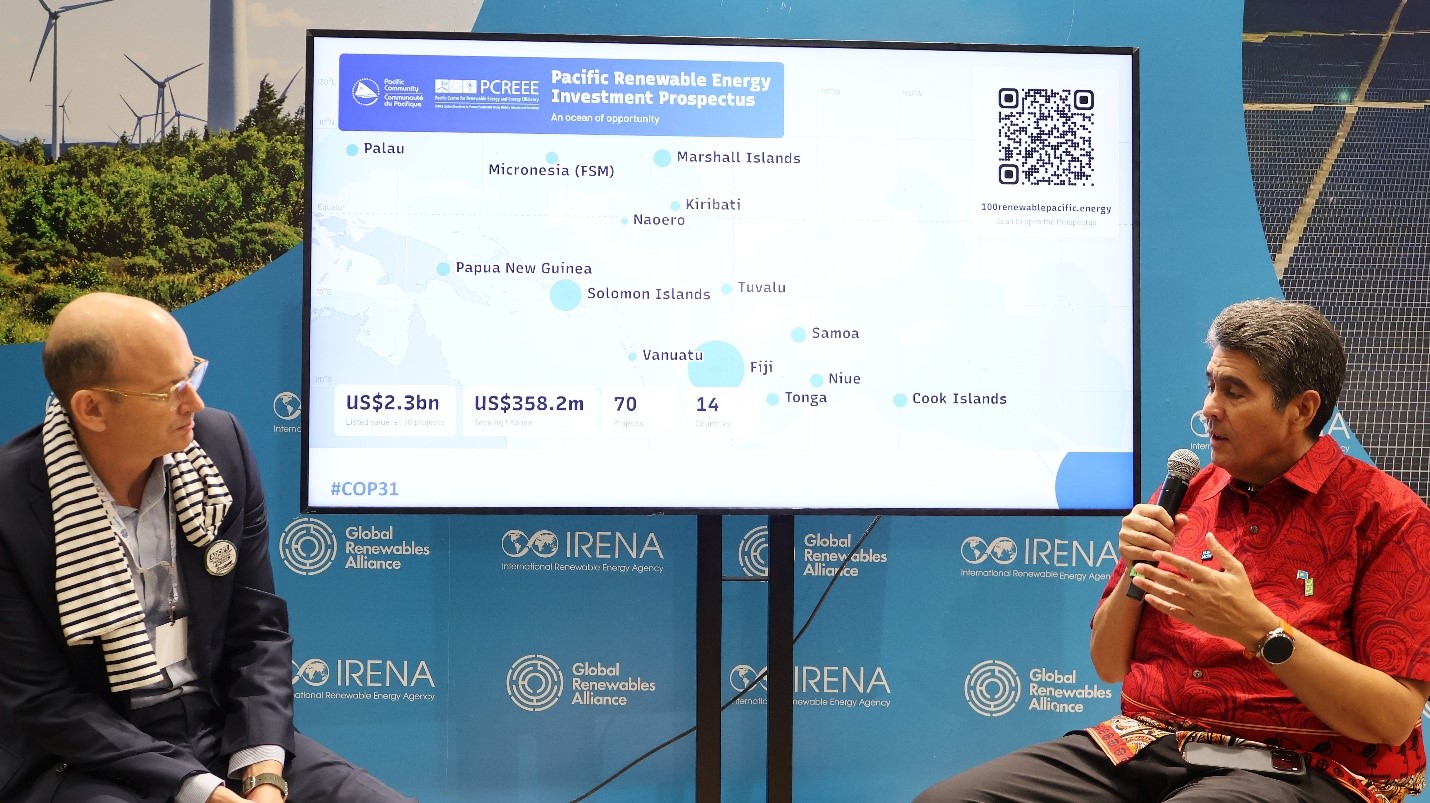
Speaking at a Global Renewables Hub side event at COP31 in Antalya, Türkiye on November 12, Whipps said Pacific countries needed investment to turn regional commitments into projects that deliver affordable electricity.
The investment push was ultimately about limiting warming beyond the 1.5-degree threshold. “The ultimate effort is to limit the overshoot of 1.5,” Whipps said, linking renewable energy investment and electrification to that goal.
A Pacific Renewable Energy Investment Prospectus (PREIP) identifies more than 70 projects across 14 countries, representing over US$2 billion in potential investment. The figure represents investment opportunities, not funding already secured.
“Transitioning now is not only good for the planet, it’s good for the pocketbook,” Whipps said.
But he acknowledged that Palau’s experience showed the difficulties of delivering the transition. The country had aimed to reach 45% renewable energy by 2025 but was only at 25%, he said.
An Australian-supported private solar project faced problems connecting to the electricity grid and lacked sufficient battery storage. Despite those challenges, Whipps said it demonstrated the potential to reduce power costs.
He put the renewable project’s electricity supply price at 14 cents per kilowatt-hour, compared with 28 cents for diesel-generated power.
Whipps said Palau’s initial 15-megawatt solar development had provided a basis for expansion. The country was now seeking investment in another 30 megawatts of generation and additional battery storage.
He said grouping projects across the Pacific could help small island economies attract investors and secure lower costs than they could achieve individually.
The regional renewable energy ambition gained support through the Manubada Call to Action, adopted by Pacific energy and transport ministers in Papua New Guinea in May 2026.
Pacific leaders reinforced it through the BELAU Declaration at the 55th Pacific Islands Forum Leaders Meeting in Palau.
The investment prospectus was developed by SPC through its Pacific Centre of Renewable Energy and Energy Efficiency, with technical partners. It is intended to connect government and utility projects with development finance institutions and investors.
Bruce Douglas, chief executive of the Global Renewables Alliance (GRA), said renewable energy companies were ready to invest in the islands but needed supportive policies, cooperation, and financing.
“To move from pledges to projects, we need those frameworks, we need the policies in place,” Douglas said.
The discussion also highlighted policy barriers. GRA co-founder Jonas Moberg said Fiji Minister of Information, Environment, and Climate Change Lynda Tabuya, speaking at an International Solar Alliance meeting the previous day, had identified a lack of government reform as an obstacle to renewable energy development.
Moberg raised the need for utilities to establish rules that support rooftop solar and asked how governments could accelerate those reforms.
Whipps said Palau faced similar difficulties. He said members of parliament continued to favor diesel subsidies and argued that credible technical information and completed renewable energy projects could help demonstrate the benefits of switching.
Grants and financing packages combining low-cost loans with commercial funding were also essential to making projects affordable, he said.
“Only through partnership and investment and ultimately building it, that’s what’s going to make the difference.”
The side event, co-hosted by Palau’s government and the GRA, sought investment and technical support for renewable generation, grids, storage, and related infrastructure.
Whipps said the region was ready to move beyond commitments.
“We’ve got the projects, now we just need the interest.”